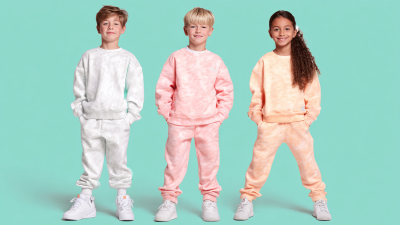
2026 Best Kids Tracksuits for Wholesale Buyers
Wholesale buyers need more than a good-looking set. Kids Tracksuits must balance comfort, durability, consistent sizing, and dependable supply. A soft brushed interior feels inviting on a cool morning, while sturdy seams and smooth zippers matter after repeated washing. Small details count.
Children’s activewear sourcing consultant Maya Chen puts the buying principle this way: “A strong tracksuit earns repeat orders when comfort, fit, and fabric quality hold up beyond the first wear.” For buyers, that means checking fabric weight, stretch recovery, colorfastness, and size grading—not just the sample’s appearance. Ask suppliers how they inspect production lots. Request measurements across several sizes. Confirm that colors and trims stay consistent between reorder batches.
This guide to 2026 Best Kids Tracksuits for Wholesale Buyers will compare practical options for different customer needs, from lightweight school-day sets to warmer fleece styles. It will also cover materials, construction, fit, customization, and supplier evaluation. A polished sample is useful, but it is not proof of reliable bulk production. That distinction is easy to miss. Some buyers may still prioritize the lowest unit price; that can be a costly shortcut when returns rise or repeat stock arrives with uneven sizing. Use clear specifications, inspect samples carefully, and leave room for honest uncertainty. No checklist removes every risk.
2026 Kids’ Tracksuits: Product Scope and Wholesale Buyer Criteria
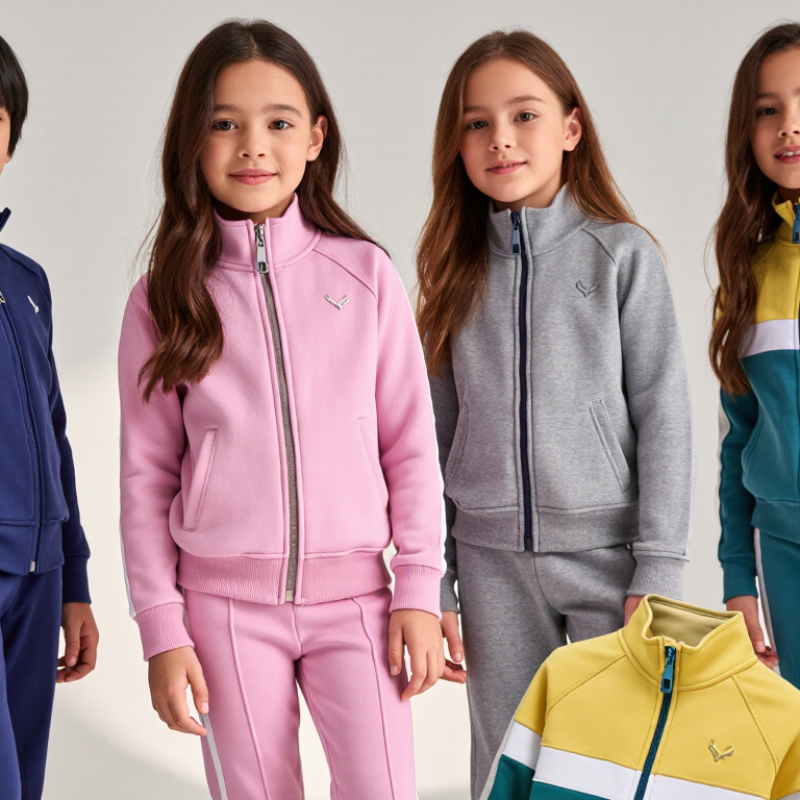
For wholesale buyers, the 2026 kids’ tracksuit category includes coordinated tops and bottoms for school, travel, play, and everyday wear. Product scope may range from lightweight zip jackets with elastic-waist joggers to warmer brushed-fleece sets. Check whether pieces are sold only as sets or can be ordered separately. That choice affects size planning and stock flexibility.
Evaluate fabric weight, hand feel, and construction on a physical sample. Rub the inside surface, check zipper movement, and inspect seams around knees and pockets. Small details matter. Ask for a clear size chart, garment measurements, available colors, and a sample across more than one size. A chart can still mislead. Children’s proportions vary, and fit may change between size groups, so compare measurements rather than relying on age labels alone.
Wholesale criteria also include minimum order quantities, size ratios, repeat-order options, and production timelines. Request details in writing and confirm how color or fabric substitutions are handled. Wash-test samples for shrinkage, pilling, and color change before placing a larger order. Fit varies. A heavier set may feel durable but suit fewer climates; a light set may sell across seasons yet wear differently. There is no perfect balance, and buyers should judge it against their customers and intended retail price.
2026 Kids’ Tracksuits: Product Scope and Wholesale Buyer Criteria
Use these illustrative 1–5 planning scores to compare key wholesale considerations. They represent a sample buyer checklist, not survey results or market statistics.
Fabric Selection and GSM: Balancing Warmth, Breathability, and Cost
For wholesale buyers choosing kids’ tracksuits in 2026, GSM is a useful starting point, not a quality score. Around 220–280 GSM often suits everyday school and play sets in mild weather. A brushed inside adds warmth, but can hold heat during active play. Not always ideal.
Fabric composition matters just as much. Cotton-rich knits feel soft and absorb moisture, while polyester blends often dry faster and keep their shape. A smooth interlock can work well for lightweight sets; a fleece-backed knit feels warmer against the skin. Ask suppliers for the fiber breakdown, fabric construction, and finished-garment weight. Touch matters. Two fabrics with the same GSM can feel very different.
I would compare samples in the intended size range, rather than approving one swatch alone. Check seams after washing, and note shrinkage, pilling, and color change. These checks take time, but a small sample run can reveal issues before a large order. Higher GSM may also raise fabric use, shipping weight, and cost without improving comfort for every market. That trade-off is easy to underestimate. A practical choice balances local climate, expected wear, and the buyer’s target price—not warmth alone.
Fit and Trim Safety: Applying EN 14682 Drawcord Requirements
2026 Best Kids Tracksuits for Wholesale Buyers
Fit and Trim Safety: Applying EN 14682 Drawcord Requirements
For wholesale buyers, a tracksuit’s drawcord deserves the same attention as its fabric and stitching. EN 14682 sets safety requirements for cords and drawstrings on children’s clothing. Rules depend on the child’s age or height, garment area, and cord design. Hood and neck drawcords are particularly important: they are generally not permitted for young children. Requirements for older children can differ. Check the current standard and the applicable market guidance before approving a style.
Inspect the actual garment, not only the tech pack. Pull the waistband cord gently, check how it is secured, and look for loose ends, loops, or toggles. Small details matter. A sample can pass inspection while a later production run changes cord length or trim. Ask suppliers to document measurements and review production samples against the approved specification. Keep records of checks and any corrective action. A size label alone is not enough. I have seen trim details treated as minor; that assumption needs a second look. If a requirement is unclear, consult a qualified testing professional rather than relying on visual checks alone.
U.S. Compliance: CPSC’s 100 ppm Lead Limit for Children’s Products
For wholesale buyers, the 100 ppm lead limit applies to accessible component parts of children’s products, not simply the garment as a whole. The U.S. Consumer Product Safety Commission’s guidance distinguishes this limit from the separate 90 ppm limit for lead in paint and similar surface coatings. Check trims closely. Zippers, snaps, decorative studs, and printed details can all need review. A supplier’s general compliance statement is useful, but it is not a substitute for product-specific test records.
The Centers for Disease Control and Prevention’s 2021 blood lead reference value is 3.5 micrograms per deciliter, based on levels among U.S. children ages one to five. It is a public-health reference, not a safe exposure threshold. That detail matters. For a tracksuit, request reports identifying the tested materials, colorways, and component parts, and confirm testing came from a CPSC-accepted laboratory when required. Keep records linked to each style and production lot. A tiny metal zipper pull may look harmless; appearance cannot establish lead content. Paperwork can be incomplete, too, so buyers should verify that the report matches the actual garment.
Quality Control: ISO 6330 Wash Testing and ISO 105-C06 Colorfastness
For wholesale buyers, a kids’ tracksuit should keep its shape and color after repeated home washing. ISO 6330 sets controlled domestic washing and drying procedures for textile testing. ISO 105-C06 assesses colorfastness to laundering, including color change and staining. Together, these methods help suppliers compare fabric performance under repeatable conditions. They do not, by themselves, guarantee years of wear.
Ask for reports that identify the tested fabric, wash program, detergent, drying method, and number of cycles. Check dark panels against pale cuffs, and inspect prints, seams, and elastic after washing. A pass on the main fabric may not reflect the finished garment. Small details matter.
The Textile Exchange Materials Market Report 2024 estimates global fiber production reached 124 million tonnes in 2023. That scale makes durability testing a practical sourcing tool: fewer early failures can mean fewer avoidable replacements.
Still, test results need context. One sample is not a whole production run, and laboratory washing cannot reproduce every household routine. I would want random production samples tested, even when the first report looks reassuring.